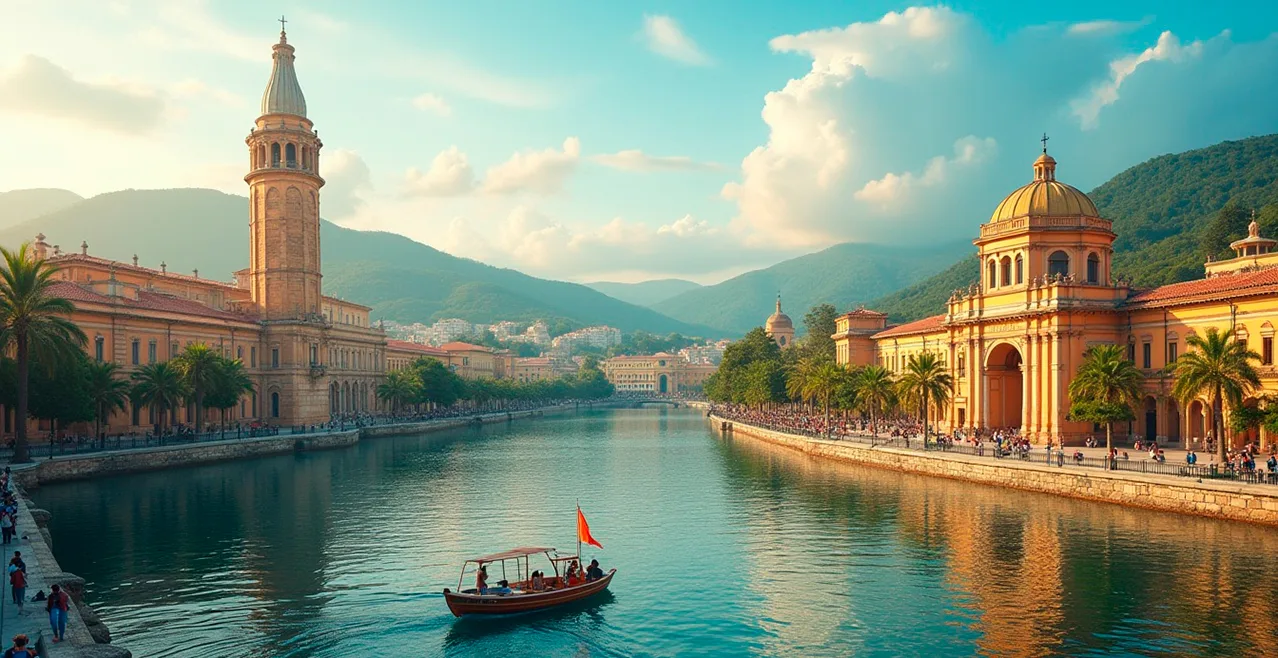
Colombia is located in the far north of South America, with its capital, Bogota, featuring the famous Zona Rosa district, full of shops and restaurants. Colombia is a unitary, social and democratic state, and the seventh largest country in America. Across the Caribbean Sea, it is the only nation in South America with shores on the Pacific and access to the Atlantic. It has just over 51 million inhabitants, and its population is multicultural. The presence of the Colombian population dates back 14,500 years. From 1810 and after the war of independence, the country we know today as Colombia emerged, with a diversified economy and great importance in services. Its name comes from the surname of Christopher Columbus, in Italian Colombo, hence Colombia. Its official language is Spanish, and around 65 languages are co-official in their respective territories, including English. One of its strengths is its music, the most important in Latin America, with artists known all over the world. Its national sport is Tejo, and the most popular is soccer, but it was in boxing that they won several world titles. Its coffee is notorious and recognized worldwide; Colombian coffee is a registered trademark with denomination of origin, being the largest producer of mild coffee in the world. Another precious jewel of Colombia are its emeralds, and it is the largest producer.
The climate in Colombia is diverse, with three types depending on the altitude: the hot climate with temperatures above 24 C (at less than 1,000 m above altitude), the temperate climate with temperatures of 17 to 24 C (between 1,000 and 2,000 m above sea level), and the cold climate which varies between 11 and 17 C (between 2,000 and 3,000 m above sea level).
Among the landscapes of Colombia there are valleys and plains such as the Cauca Valley or the Pacific Plain. Also mountains and mountain ranges, such as the Sierra Nevada de Santa Marta in the Andes Mountains, where the Don Diego River has its source and flows into the Caribbean Sea.
Ranked among the top ten world destinations, notable places to visit include: the Candelaria neighborhood in Bogota, with its walls; the beaches of Cartagena de Indias; the islands of Rosario; the beaches and the historic center of Santa Marta; the Guajira desert; and some of its colonial towns such as Santa Fe, Popayan, Tunja, and more.
The currency is the Colombian Peso ($) (COP). The time zone is GMT / UTC-05:00, corresponding to -6h (-7h in daylight saving time), Central European Time.
Colombia is known worldwide for the quality of its medicine, with great achievements such as the creation of malaria vaccine, pacemaker, LASIK surgery, Hakim valve, and also pioneers in pediatric robotic surgery. It is also the country with the highest universal health care in Latin America. Its health system can be private or public, and both have universal coverage and equal access to medicines, treatments, interventions, medical and dental services. Colombia surpasses Canada and the United States in its health system, and has high-level doctors with extensive experience, with the best hospitals in Latin America with state-of-the-art technology and facilities. This makes Colombia currently one of the best options for carrying out a surrogacy process.
In Colombia, its education system is regulated by the state, and it has a public funding organism to get into university.
Colombia has no national dish and its gastronomy is varied and changes according to each region. Among the most representative regional dishes are sancocho, arepa, santafereno ajiaco, bandeja paisa, el mote de queso, Tolimense suckling pig, mamona or veal a la llanera, santandereano mute, tamal, lisa rice and fish, especially in coastal areas. As a drink, they enjoy Guarapo, made from sugar cane.
Various and numerous festivals include: Medellin Flower Fair, Barranquilla Carnival, Cali Fair, and Bogota Ibero-American Theater Festival. These include visits by tourists during their stay in the country.
There is no exclusive right, but it is practiced normally and is considered completely legal. The constitution states that all children born naturally or with scientific assistance have the same rights. In addition, the Colombian court ruled on equality with the same rights and guarantees for foreigners, as set out in article 100 of the constitution. For the LGBT community, they can also perform the process, as long as one of the parents brings genetic material. To achieve this, a clear consent is signed between the parties.
We ensure that our surrogate mothers in Colombia meet the following requirements:
There are direct flights or with stopover(s) from the main European capitals. Nationals of European Union countries do not need a visa if they are visiting Colombia for tourism purposes and for a period of less than 90 days. However, a valid passport (with 6 months validity) and a return ticket are required. If a stopover is made in the USA, it is necessary to process the authorization "ESTA".
Take the first step on your journey to parenthood. Our team is ready to guide you through every stage of the surrogacy process in Colombia.
Book a Free Meeting